
Five steps to make any product, service, or part of your small business better.
|
|
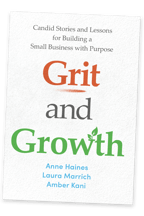
"A lot of people would come by my table and say, 'Wow, you've created all this? How can we get more information?'" Domonique says in DreamSpring's new book, Grit and Growth: Candid Stories and Lessons for Building a Small Business with Purpose (Wiley). From that feedback, she realized there was market demand for much more than she was currently offering. She responded by launching new products, then retreats. Today, ForBrownGirlss promotes mental health awareness for Black and Brown women through a line of smartly designed products, as well as educational resources and wellness events. "Every vending opportunity shows me what products fit best, or how I can improve a product or my message," she says. "Every event teaches me something about how to do it better next time." |
|

Paying attention to customer feedback, then iterating on it, is how businesses expand and improve over time. Read on for a simple five-step process for improving your own strategies, products, or services — and don’t forget to download our free Product and Service Improvement Worksheet to work through it alongside this guide!
Iteration: The Entrepreneurial Dance
Most successful products and services don't arrive fully formed. Grit and Growth describes the iterative process as dance, jokingly named the “Entrepreneurial Two-Step": Two steps forward, one step back. Come up with an idea, find it's not quite right, refine it, try again. Even though it can sometimes feel slow motion, you’re ultimately moving forward by taking a series of small, calculated risks. In our experience walking alongside thousands of entrepreneurs, that is the sweet spot for many small businesses. (Including here at DreamSpring, which is also a nonprofit small business!)
The steps that follow are designed to help you develop that practice intentionally — by listening for what needs to change, brainstorming what to try, testing it at small scale, learning from what happens, and repeating the cycle until you land on a solution that works for your business.
1. Listen
Domonique's most useful feedback came from being present at her table and paying attention to what people said and asked. Her vending tables were, functionally, a feedback system.
For businesses that aren't table-based, the equivalent might be asking a question at the end of every session or transaction. It could be, “What would make this more useful for you?” A follow-up conversation after an event, or paying attention to what people share about your work online, can serve the same purpose. With consistent feedback, patterns about what to improve will start to emerge.
2. Brainstorm
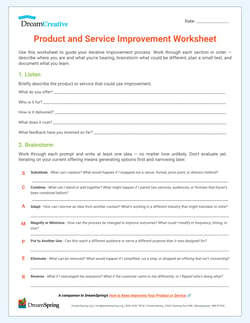
When you're ready to take that feedback and think about how to change, a brainstorming method called SCAMPER gives you seven new angles to apply an existing product or service. You don't have to work through all seven, but running through them can surface ideas or solutions you may not have thought of otherwise.
S Substitute — What can I replace? What would happen if I swapped out a venue, a format, a price point, or a delivery method?
C Combine — What can I blend or add together? What might happen if I paired two services, two audiences, or two formats that haven't been combined before?
A Adapt — How can I borrow an idea from another context? What's working in a different industry that might translate to mine?
M Magnify or Minimize — How can the process be changed to improve outcomes? What could I modify in frequency, timing, or size?
P Put to Another Use — Can this reach a different audience or serve a different purpose than it was designed for?
E Eliminate — What can be removed? What would happen if I simplified, cut a step, or dropped an offering that isn't connecting?
R Reverse — What if I rearranged the sequence? What if the customer came to me differently, or I flipped who's doing what?
Domonique's business has moved through many of these. She launched events and retreats in response to what people were asking for at her vendor table. She combined wellness education with community-building and credentialed experts. She adapted the retreat format, common in the broader wellness industry, into a mental health context for an underserved community. She scaled from 10 women in one city to multiple events across multiple cities, and experimented with shorter, more accessible formats along the way.
|
|
Download our free Product and Service Improvement Worksheet to try these prompts out on your own business. → |
|
3. Try
Domonique's first retreat was 10 women in Galveston, Texas — not a fully scaled operation, but a test she could learn from. When the response from the participants, and in her own gut, was overwhelming, she had her answer. "I felt so impassioned the entire time," she says. "It was a feeling of, 'Wow, this is what I'm supposed to be doing.'"
For most small businesses, a test doesn't require a full launch. It might be a one-time pilot at reduced capacity, such as an informal offer to a small group of existing customers or a single workshop before committing to a program. Find out what works with the smallest investment possible, then add on from there.
For more ideas and examples of iterative testing, check out the resources offered by the IDEO Design Thinking toolkit and Stanford d.school.
4. Learn
After each test, do a quick debrief. What worked? What didn't? What did people ask for that you didn't offer? What did people gravitate toward, and what didn't resonate? Write down the answers so that you have a record you can return to.
It's helpful and rewarding to take note of your hits. But paying attention to your misses may be even more important. As the popular saying goes: When you lose, don’t lose the lesson. "I read somewhere that every failure is a step closer to success," Domonique says. "Embracing failure, change, and the rough moments, even now, really helps you as an entrepreneur. Not only do you gain experience and information, it gives you the resilience to start over again."
|
|
Use our free Product and Service Improvement Worksheet to document what you learn after each test and carry those insights into the next iteration. → |
|
5. Repeat
The discovery that comes from the back-and-forth of setbacks and successes is a normal and, ultimately, clarifying part of the entrepreneurial process. And like any dance, it helps to have a partner. Find a peer you can ask for feedback, bounce ideas off of, and lean on when you're working through change. (DreamSpring's In the Community page is one place to find that.) "When you don't see the growth in yourself or your business, the people around you will remind you that the things you're doing are necessary and helpful," Domonique says.
Then get right back out on the dance floor and take your next step.
Quotes excerpted from Grit and Growth: Candid Stories and Lessons for Building a Small Business with Purpose (Wiley), Chapter 5, "Breakthroughs: Small Wins, Creativity, Resourcefulness, and Perseverance."
Also in this series: How to Write a Great Employee Handbook and How to Find Your Best Customers.
For more small business resources, visit the DreamSpring Business Resource Library.