
Have one or more employees? You need an employee handbook. Here’s what to write, when to write it, and how to keep it current.
If you’ve recently hired your first employee — or you’re about to — an employee handbook should be near the top of your to-do list. It’s the document that tells people what it means to work for you: policies, expectations, benefits, and consequences. If those things are unwritten, it will create inconsistent application and enforcement issues for the team, as well as inefficient and time-consuming communication challenges for you.

Magpie Games Co-Owner Mark Diaz Truman (second from right) sits on the dock of the loading bay with a few Magpie employees.
|
|
Mark says taking that approach to human resources isn’t easy, but it’s necessary for his business. “It’s really hard to make choices that work for everybody, and set it up, and maintain it. But we had to, because all our values point that way,” he says. |
|


Here’s how to assemble your own company’s handbook, and codify your organizational values and culture alongside it, with resources and templates to help you through the process — including our own Employee Handbook Builder worksheet that’s designed be used in tandem with this guide.
1. Figure out who needs to be involved.
Before writing anything, identify your stakeholders. Internally, that means whoever leads the organization plus anyone handling operations or human resources (HR). Externally, it means a lawyer — employment law varies significantly by state and locality, and the cost of getting it wrong is high. If you have a board, loop them in early.
Every line needs a human who knows your organization, and every policy needs legal sign-off before it goes to staff. Alignment upfront means fewer rewrites later.
|
|
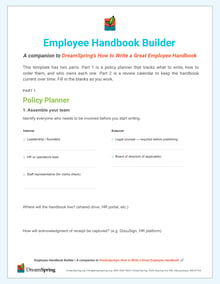
Our free Employee Handbook Builder uses a phased approach that assigns an owner to each topic for accountability. It really works! → |
|
2. Start with a few policies (not all of them).
Some small business owners spin out trying to document everything at once, which can lead to never starting or a half-finished document that doesn’t reach the finish line. Start with the legally required sections — anti-harassment, discrimination, workplace safety — then move to the areas that create the most friction day to day.
Small business owners we’ve worked with often flag PTO and attendance, remote work expectations, and benefits as the hardest to get right. Plan extra time for those. One more that’s easy to overlook is an AI and data security policy. If your team uses external AI tools like ChatGPT, you need explicit guidelines about what company data can and can’t go into them.
Once you have a foundation, keep layering onto it when you have the bandwidth to do each section properly. A good handbook grows with the organization.
SCORE’s employee handbook guide is a great place to get the basics down.
|
3. Write it for someone on their first day.
Remember that your handbook has to work for new hires — people who are possibly nervous and definitely trying to figure out what’s expected. That means plain language, specific consequences, and transparency about flexibility and benefits.
There’s another practical benefit here, too: A well-structured handbook means the organization can function without the founder in the room, which Mark calls “game-changing” for any entrepreneur who’s felt trapped by their own business.
|
The Tory Burch Foundation’s resources on building your team go deeper on the people side of the equation, including how to develop and retain staff once you’ve got them. |
4. Share it on day one and get a signature.
The handbook should be the first thing a new hire reads. Require a signed acknowledgment — because a signature means they consent to your policies, and it gives you a record if a dispute arises later. Tools like DocuSign or your HR platform can capture this digitally and store it automatically. Keep the document somewhere everyone can find without asking.
|
If you’re still building out your onboarding process more broadly, DreamSpring’s Strategic Planning for Creative Growth is a useful companion for thinking about how your handbook fits into the bigger picture of running a sustainable operation. |
5. Keep it current, and assign someone to own it.
Your handbook is a living document. Most organizations do a full review annually — January works well if that’s not part of your busy season — but that shouldn’t be the only time it changes. If a policy shifts mid-year because there’s a new law, a change in how your team is structured, or a process isn’t working, update it and tell people immediately. Don’t make people wait until the annual cycle to find out the rules are different.
Breaking reviews into quarterly chunks can make the work more manageable: onboarding and key policies in Q1, culture and expectations in Q2, compliance and safety in Q3, and a full review with feedback collection in Q4. Assign a specific person to own it. Reviews that belong to everyone tend to happen for no one.
|
The Department of Labor’s Employment Law Guide is a free, authoritative reference for federal requirements. Your state’s labor department will have the equivalent for local requirements. |
|
|
Mark describes what happens when, after a year or two of grinding hard in startup mode, a founder finally takes a few weeks away from the business. “All the holes in the dam that you are plugging with your 12 million entrepreneur fingers will suddenly become obvious,” he says. “The people whom you hopefully have hired, nurtured, structured, and grown will then fix them.” A big part of that structure comes from your handbook. |
|

Quotes excerpted from Grit and Growth: Candid Stories and Lessons for Building a Small Business with Purpose (Wiley), Chapter 4, The People Factor: Relationships, Culture, and Communication.
For more small business resources, visit the
DreamSpring Business Resource Library.