
Your SMART goals deserve a SMARTIE upgrade!
If "strategy" is a word that makes you uncomfortable, you're not alone. It sounds corporate and rigid, like something that belongs in a boardroom rather than a studio. But strategy is just how you choose to focus your energy. And for creative entrepreneurs, having a framework for those choices can make all the difference.
The SMARTIE framework approaches goal-setting with your whole situation in mind — caregiving, finances, health, access, community. Because a goal that ignores real life doesn't have much of a chance.

Learn how to set effective seasonal SMARTIE goals that align your creative business with real-life considerations for support and sustainability.
Getting the timing right is just as important. Your capacity in January probably looks nothing like your capacity in October. Inspiration and bandwidth fluctuate, and planning around seasonal rhythms makes managing your work (and your decisions!) so much easier.
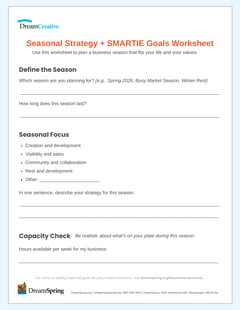
Read on to learn how to set better goals using the SMARTIE framework — and don’t forget to download our free companion worksheet so you can follow right along with your small business.
Strategy vs. Planning
Planning and strategy serve different purposes. A plan tells you what you're going to do; a strategy tells you why you're doing it. Listen to the Harvard Business Review's podcast episode on the Difference Between a Plan and a Strategy for a quick 15-minute primer.
For creative entrepreneurs, the difference shows up in how your decisions get made. A plan says: Here are all the things I want to accomplish this year. A strategy says: Given my current capacity, relationships, and goals, here's what I'm choosing to focus on this season — and here's what I'm consciously setting aside.
Seasonal strategy takes this further by aligning priorities, resources, and goals to the natural rhythms of your work. That can mean recognizing that spring is when market sales peak, so winter is for making. Or that momentum drops every August, so that's not the season to launch anything new.
Identifying Your Seasons
Your seasons are shaped by external factors like markets, grant cycles, the weather, or maybe the school year. They're also shaped by internal ones — when you feel most generative, when you need rest, when collaboration makes sense, or when to work alone. Every creative business runs on its own timing
|
Some common seasonal focuses:
|
Most creative businesses move through some version of these across the year, though not necessarily in that order. You can start by noticing your own patterns. Vicky Blume's Seasonal Thinking for Creative Beings on the Fractured Atlas blog has some good advice on how to identify and honor your creative seasons.
Why Stop at SMART?
You've probably encountered SMART goals before. The framework — Specific, Measurable, Achievable, Relevant, Time-bound — takes an intention and turns it into something you can act on and evaluate.
For creative work that is relational, values-driven, and shaped by access and community, SMART goals leave a gap. SMARTIE fills it by adding two more dimensions: Inclusive and Equitable. Those additions ask you to consider not just what you're working toward and by when, but whether the way you're working accounts for your capacity, your support needs, and the people your work serves or involves.
Creative goals are shaped by caregiving responsibilities, financial constraints, physical and mental health, and access to tools and space. SMARTIE goals fold those in from the start.
|
The full SMARTIE framework: Specific: What exactly are you working toward? The more concrete, the better. Measurable: How will you know when you've reached it? Achievable: Is this realistic given your current resources and capacity? Relevant: Does this align with where you want your business to go this season? Time-bound: What's the deadline or timeframe? Inclusive: Does this goal account for the people involved, including your own support needs? Equitable: What support, access, or adjustments do you need to make this goal sustainable? |
Setting Seasonal SMARTIE Goals
Choose one to three strategic priorities per season. Resist the temptation to do any more, as spreading your focus too thin means ending your season without any breakthroughs.
Two examples of what a seasonal SMARTIE goal looks like in practice:
A ceramicist heading into a fall market season: By the end of October, I will have produced 40 saleable pieces across three consistent glaze colorways, working four studio days per week during the hours my kids are in school, and will have photographed and listed each piece by the last week of September. I'll check in with a fellow maker monthly to stay on track and share what's selling.
A muralist in a community and collaboration season: By the end of this quarter, I will complete one public mural in partnership with a neighborhood organization I've already connected with, attending two community input sessions before finalizing the design, and keeping the project scope manageable enough that it doesn't require unpaid overtime.
|
|
Ready to give SMARTIE goals a go? Download our free worksheet and set your first seasonal goal. → |
|
Strategy >> Action
Once you've identified your season and set your goals, translate them into the shape of your week. What days are studio days? What recurring habits keep your work moving? What's the one thing that has to happen this week for the goal to stay on track?
Decide what you're not focusing on this season. Every yes implies a no, and naming the nos explicitly keeps you from quietly overcommitting. If this is a creation season, visibility can wait. If this is a rest season, a new product launch can wait.
Leave room for flexibility. Life changes, creative work surprises you, and a seasonal strategy has to accommodate that. For a broader look at strategic planning for your creative business, check out DreamSpring's Strategic Planning for Creative Growth article and worksheet.
What Goes Sideways
The number one thing that doesn’t work: treating every season like a growth season. Rest and reflection are seasons too, and a business that is always in launch mode eventually runs out of gas.
Carrying the same goals from one season to the next without reassessing them is another pitfall. If a goal has rolled over twice already, it may be generating more guilt than momentum.
Setting goals without accounting for the support you need won’t work, either. If a goal requires more hours than you have, and childcare or a health flare or a cash flow crunch is unaccounted for, the goal is a wish.
Then there's confusing a full calendar with a focused season. If you can't say what your current season is for, find the focus and make yourself stick to it.
Start Here
Seasonal strategy works best as a practice. You don't need to map the whole year before you can begin. Pick the season you're in now, or the one coming up next, and set one SMARTIE goal that reflects what you want to create and what you can sustain.
As goals evolve and seasons shift, a seasonal SMARTIE goal is how you keep your values, creativity, and business growing together.
For more on running a sustainable creative business, visit the DreamSpring Business Resource Library.