
How to build a pricing strategy that sustains your creative business — today, and as you grow.
Pricing is one of the most important — and most misunderstood — parts of running a creative business. It's where a lot of creative entrepreneurs quietly struggle.
Set your prices too low, and you risk burnout, cash flow challenges, and stalled growth. Set them too high without the right context, and you may find it hard to convert customers. And if you've been copying what competitors charge without really knowing your own numbers? That's one of the most common and costly mistakes in the creative economy.
The reality is: Strong pricing isn't guesswork. It's a balance of costs, value, and market demand. And it's a skill you can learn — even if math has never been your favorite medium.

Pricing your work starts with knowing your numbers.
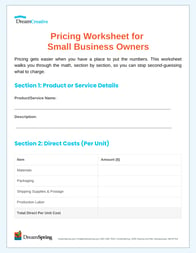
This guide walks you through how to build a pricing strategy that works for your business. Use it alongside our free Pricing Worksheet to put the math into action.
|
|
Ready to run the numbers? |
|
Step 1: Understand Your True Costs
Before you can price anything with confidence, you need to know what it actually costs you to deliver your product or service. This includes more than materials — your time, your overhead, and the money you spend getting customers in the door are costs.
Direct Costs (Cost of Goods Sold – COGS)
These are the costs directly tied to making or delivering your work:
-
Raw materials or inventory
-
Packaging
-
Shipping supplies
-
Production labor (if applicable)
|
|
📝 Example — Handmade Candles:Wax, wicks, fragrance oils = $6 | Packaging = $2 | Shipping materials = $1 |
|
Indirect Costs (Overhead)
These are the expenses that keep your business running — even when you're not actively making anything:
-
Rent or workspace cost
-
Software subscriptions
-
Website hosting
-
Insurance
-
Utilities
|
💡Tip: Divide your total monthly overhead by the number of units you sell to estimate a per-product overhead cost. |

Marketing & Customer Acquisition Costs
Many creative entrepreneurs forget to factor this in — but it's a non-negotiable. Every dollar you spend getting someone to your Etsy shop, your website, or your studio counts. Marketing and customer acquisition costs include:
-
Paid ads (social, Google, etc.)
-
Email marketing platforms
-
Branding and design
-
Promotions or discounts
📝 Example:If you spend $500 per month on marketing and sell 100 units, that's $5 in marketing cost per product. |
Your Time (Yes — You Must Pay Yourself)
Your time is not free, and treating it that way is one of the most common pricing mistakes in the creative economy. Ask yourself: How long does it take to create or deliver this product or service? What hourly rate do you need to earn to sustain yourself and your household?
📝 Example:1 hour per product × $25/hour target wage = $25 labor cost per unit. |
Not sure what to pay yourself? This overview of pricing strategies for small businesses from QuickBooks breaks down how to think about margins and labor across different business types.
Step 2: Calculate Your Baseline Price
Now, add everything together to find your break-even point:
-
Direct Costs: $9
-
Marketing per unit: $5
-
Labor: $25
-
Overhead allocation: $6
📝 Example:Total Cost = $45 |
Not confident about your numbers yet? Our free Pricing Worksheet walks you through each category with space to fill in your own figures, step by step.
|
|
Do the math with us. |
|
Step 3: Add a Profit Margin
Profit isn't optional — it's what allows your business to grow, absorb unexpected costs, and reinvest in your craft. A sustainable business can’t just break even.
Typical small business margins:
-
Product-based: 20–60%
-
Service-based: 30–70%+
📝 Example:If your total cost is $45 and you want a 40% profit margin: |

Step 4: Validate Against the Market
Now that you have a cost-based price, it's time to look up and see where you land in the market. Ask yourself:
-
What are competitors charging for similar work?
-
Where do I fit — premium, mid-range, or budget?
-
What makes my offering different or more valuable?
Here's the key mindset shift: You are not trying to be the cheapest option. You're trying to be appropriately priced for the value you deliver. Handcrafted work, specialized skills, and unique creative vision all command a premium — and customers who understand quality will pay for it.
|
💡Tip: This guide on how to price design and creative services from The Futur is a great resource for thinking through the client conversation that often accompanies pricing creative work. |
Step 5: Adjust for Demand and Positioning
Pricing isn't static — it should respond to what's happening in your business. Here are two important signals to watch for:
|
You may be underpriced if:
You may be overpriced if:
|
Revisiting your pricing at least once a year — or whenever your costs change — is essential. With inflation still impacting materials and overhead costs across industries, this is especially important right now.
If your business relies on multiple income streams alongside your core pricing, our article on How Creatives Can Juggle Revenue Streams can help you think about the full picture.
Step 6: Choose the Right Pricing Strategy
Once you know your numbers, you can choose the pricing model that best fits your work and your customers.
Cost-Plus Pricing
The most straightforward approach: Take your total cost and add your desired margin. Best for product-based businesses with predictable production costs — think makers, bakers, candle crafters, and artisan goods sellers.
Value-Based Pricing
Price based on the value you deliver to the customer, not just what it costs you to deliver it. This is often the most powerful model for creatives, especially for services, commissions, or bespoke work. A logo that transforms a client's brand is worth far more than the hours it took to design it.
Learn more about this approach in this breakdown of value-based pricing for creative businesses from Fiscally, which specializes in creative industry finance.
Tiered Pricing
Offer multiple options at different price points — a starter package, a signature package, and a premium tier. This increases accessibility without devaluing your work, and it naturally guides customers toward the option that fits them best.
Common Pricing Mistakes to Avoid:
|
For a deeper look at building financial habits that support your pricing decisions, check out our resources on business financial health for creative entrepreneurs.
|
|
Put this guide to practice. |
|
Final Thought
Your pricing should reflect your mission, your sustainability, and your growth — not just what feels safe or what you think the market will tolerate. If your business is meant to create opportunity, your pricing has to make that possible. Building a business that lasts start by recognizing the full value of your work.
As you grow, access to capital can also play a role in helping your creative business scale. DreamCreative — DreamSpring's specialized suite of tools, business education, and funding for artists, makers, and designers — is built to help you get there. See all the ways we support creative entrepreneurs.
|
|